

Sustainable Tank Tops and Basics for Dubai Summer
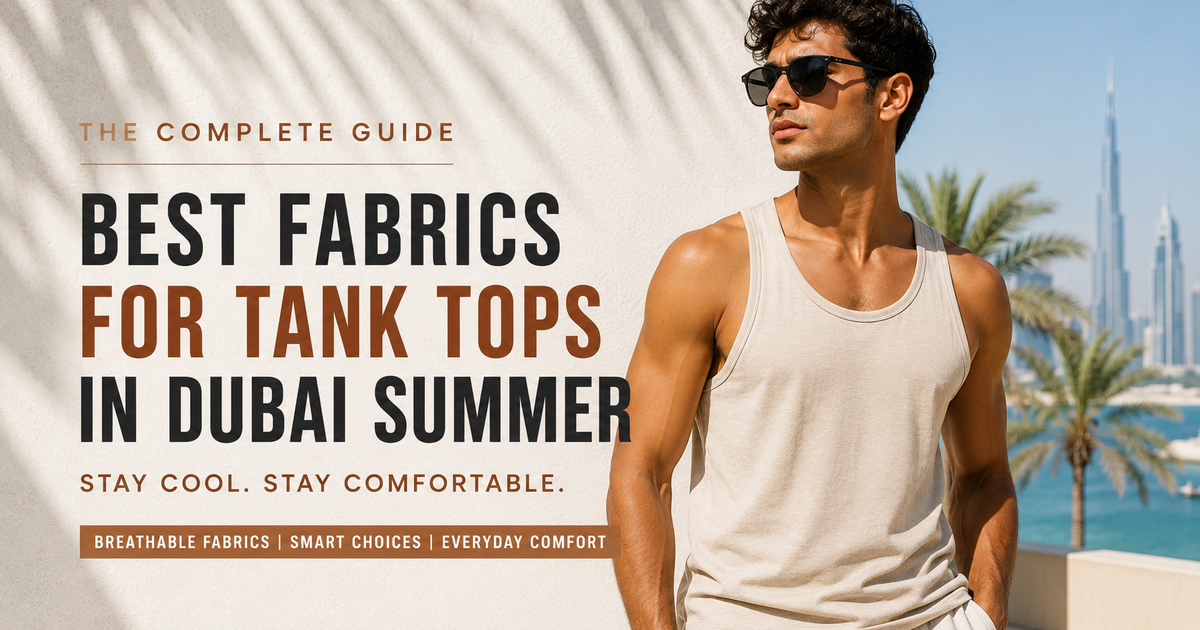
Short answer: For genuine Dubai summer heat, linen and organic cotton remain the most reliably breathable tank top fabrics, Tencel/lyocell offers a step up in moisture management for a more polished look, and recycled polyester-elastane blends make sense specifically for athletic tanks where compression and quick-dry matter more than natural fiber feel.
Why the tank top deserves its own fabric logic, not a generic summer list
A tank top's entire function is heat management with minimal coverage — which means fabric choice matters more here, proportionally, than for a garment that's already doing more covering and structural work. The same fabric hierarchy that applies to tees and polos elsewhere in this series holds here, but the stakes are higher: there's less fabric total, so what fabric you do choose carries more of the comfort burden.
The everyday hierarchy for genuine heat
- Linen — the strongest natural cooling performance, at the cost of a more relaxed, textured look rather than a crisp fit.
- Organic cotton — the reliable daily default, breathable and soft, with the same moisture-absorbency tradeoff as covered throughout this series (it gets damp rather than wicking).
- Tencel/lyocell — a genuine step up for a more polished, structured tank that still manages moisture better than standard cotton — worth the modest price premium if you want a tank that reads as put-together rather than purely casual.
The athletic tank exception
For genuinely high-intensity activity — gym, running, outdoor training — the same logic covered in our men's and women's activewear pieces applies: recycled polyester-elastane blends remain the most functionally reliable choice for compression and quick-dry performance, with the acknowledged microplastic-shedding tradeoff. A cotton or linen tank works fine for a walk or errands; it won't perform the same way through a genuine training session.
What to actually check on a tank top specifically
- A named fabric, not "breathable material" as a vague catch-all — the same standard as every other category in this series.
- Fit that allows airflow — an overly tight tank defeats even the best fabric's cooling benefit, per the same convection-cooling logic covered in our polo shirt piece.
- Elastane content, if any — a small percentage improves shape retention without meaningfully changing the fabric's core breathability, common in both athletic and everyday tanks.
- Color — light shades reflect heat more reliably than dark ones, same principle covered throughout this series, though it matters proportionally more here given how much skin and fabric surface area is exposed to direct sun.
Why tanks specifically make sense as a UAE summer staple
A genuinely versatile tank does more work in UAE heat than in milder climates — it's not just a gym piece here, it's a legitimate daily-wear option layered under a shirt for sun protection, worn alone for errands, or as a base layer that manages sweat before an outer piece goes on for a more formal setting. That versatility argument, covered throughout this series for athleisure and loungewear, applies with particular force to tanks in a climate where minimal-coverage pieces are genuinely functional rather than purely aesthetic.
Where Okapi fits
Our Café Tee and activewear pieces cover adjacent territory — breathable, odor-resistant, built for UAE daily wear — though a dedicated tank top isn't currently a distinct product in our line. If a tank specifically is what you're after, the fabric guidance above applies regardless of brand, and it's worth checking whichever retailer against this same hierarchy rather than assuming "tank top" alone signals appropriate heat performance.
Frequently asked questions
What's the best everyday fabric for a tank top in Dubai heat?
Linen for maximum breathability, organic cotton as the reliable, softer daily default — both outperform synthetic blends for genuine daily heat outside of high-intensity activity.
Should athletic tank tops use different fabric than everyday ones?
Yes — recycled polyester-elastane blends make more sense for genuine training sessions needing compression and quick-dry performance, while cotton or linen suit lower-intensity daily wear better.
Does color really matter more for tank tops than other garments?
Proportionally, yes — with more exposed fabric and skin surface area than a covered garment, the heat-reflection difference between light and dark colors has more surface area to act on.
Is elastane content a problem for a sustainable tank top?
Not inherently — a small elastane percentage for shape retention doesn't meaningfully compromise the fabric's overall sustainability profile or breathability, as long as the base fiber itself is a reasonable choice.