

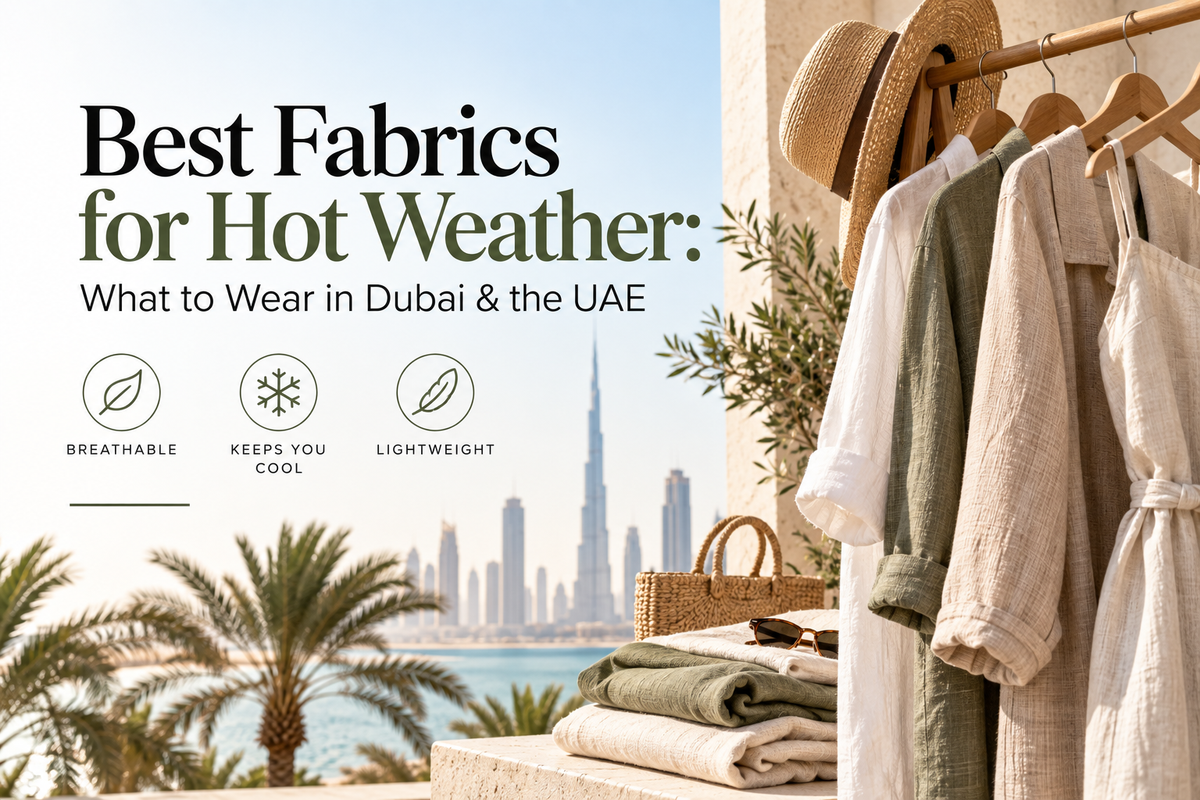
Best Fabrics for Hot Weather: What to Wear in Dubai & the UAE
Dubai style has an unusual challenge.
Outside: heat.
Inside: air conditioning.
Then outside again.
Finding the best fabric for hot weather therefore isn't only about choosing the thinnest T-shirt you can find.
Good warm-weather clothing balances fabric, construction, fit and everyday practicality.
What Makes a Fabric Good for Hot Weather?
Four things deserve attention.
1. Breathability
Air movement can make clothing feel more comfortable in warm conditions.
Fabric construction is important here—not merely the name of the fiber.
2. Fabric Weight
Lightweight materials generally place less insulation around the body.
However, extremely thin isn't automatically better. The garment still needs suitable coverage, structure and durability.
3. Moisture Management
When you're moving between outdoor heat and indoor spaces, perspiration is part of life.
How a fabric interacts with moisture can significantly influence comfort.
4. Fit
Very tight clothing can restrict airflow.
A thoughtful fit can create enough room for comfort while still maintaining a polished silhouette.
Cotton
Cotton remains one of the most familiar choices for warm climates.
Lightweight cotton can feel soft and comfortable.
However, different cotton fabrics vary significantly in weight, weave, knit and drying behavior.
Don't judge the garment from the fiber label alone.
Linen
Linen is another classic warm-weather material.
Its characteristic texture and relaxed appearance make it popular for summer shirts, trousers and resort clothing.
Its tendency to crease is either part of its charm or a drawback, depending on your style preference.
Bamboo-Derived Textiles
Bamboo is increasingly visible in contemporary clothing.
However, shoppers should understand that "bamboo fabric" can describe textiles produced through different manufacturing processes.
Evaluate the actual garment composition and brand information rather than assuming all bamboo-derived fabrics are identical.
Engineered and Recycled Fibers
Modern textile technology has expanded warm-weather clothing beyond traditional natural fibers.
Synthetic and recycled fibers can be engineered into lightweight fabrics designed for specific performance requirements.
Again, construction matters.
Coffee-Derived Textiles
Coffee-derived textile technology introduces another possibility.
Processed coffee-derived material can be incorporated into textile systems to create fabrics used for contemporary clothing.
At Okapi, this story sits at the heart of our Café collection.
The attraction isn't simply that the fabric involves coffee.
It's that something associated with your morning routine can enter an entirely different product lifecycle.
What Should Men Wear in Dubai?
For everyday use, consider building around versatile pieces:
Lightweight tees.
Clean polos.
Comfortable tanks for casual environments.
Breathable trousers or shorts appropriate to the occasion.
The objective is to avoid building separate wardrobes for every part of the day.
Choose pieces that can move between environments.
What Colors Work Well in Hot Weather?
Light colors are often associated with summer dressing, although your choice also depends on occasion, styling and fabric.
Neutral and muted shades can make warm-weather wardrobes easier to combine.
A simple polo that works with several trousers or shorts is more useful than a piece that works with only one outfit.
Frequently Asked Questions
What is the best fabric for hot weather?
There is no single winner. Lightweight, breathable fabrics appropriate for your activity and environment generally make good warm-weather choices.
Is cotton good for Dubai weather?
Lightweight cotton can be comfortable, although fabric construction and moisture behavior matter.
What should tourists wear in Dubai?
Lightweight, comfortable clothing is useful for the climate, while clothing choices should also be appropriate for the particular location and cultural setting.
Is polyester bad in hot weather?
Not necessarily. Different polyester fabrics have very different constructions and performance characteristics. Some technical textiles are specifically engineered for active or warm-weather use.
What is the coolest material to wear?
How cool a garment feels depends on several variables, including airflow, moisture, weight, fit and individual preference.
Dress for the Climate You Actually Live In

The best hot-weather wardrobe isn't necessarily the one with the most clothes.
It's the one where each piece works harder.
Choose thoughtfully.
Wear repeatedly.
And look beyond familiar fibers.
Explore warm-weather material innovation with Okapi Lifestyle.