

Ethical Men's Clothing Brands Worth Knowing
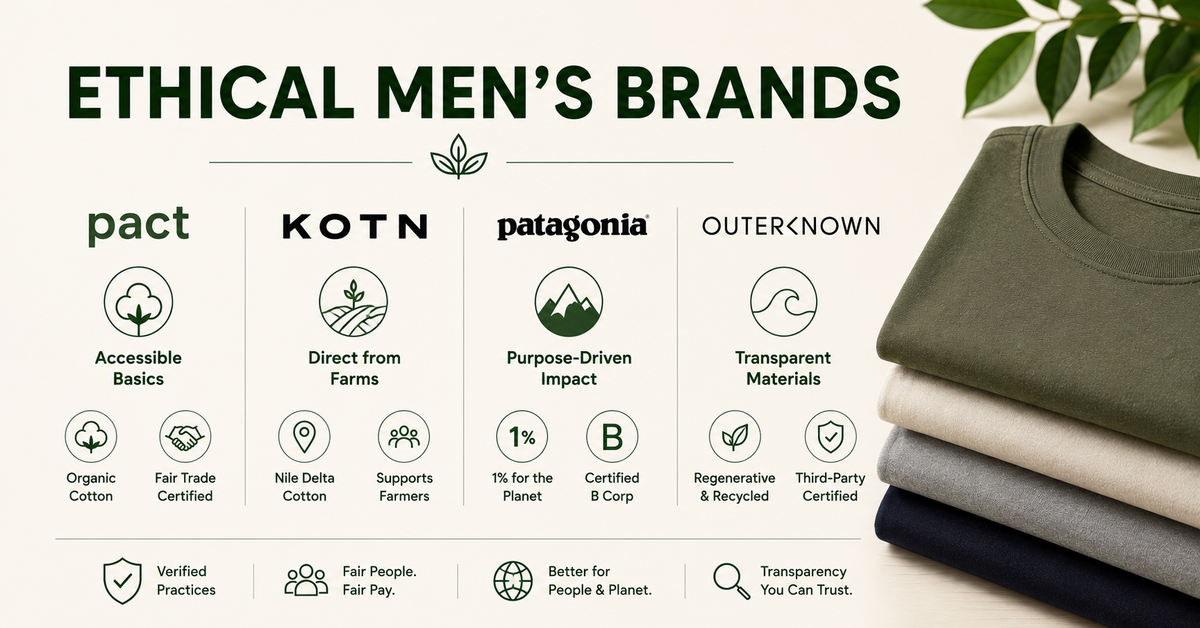
Short answer: A handful of men's brands back up their ethical claims with real, verifiable practices — named factories, Fair Trade certification, transparent sourcing — rather than just the word "ethical" on a tag. Pact, Kotn, Patagonia, and Outerknown are among the more consistently verified names, each with a different specific strength worth knowing rather than treating them as interchangeable.
As covered in our ethical vs sustainable breakdown, "ethical" specifically means fair treatment of the people making the clothes — wages, safety, transparency — a different question from material sustainability. Here's who actually backs that claim up with something checkable.
Pact — the accessible everyday basics pick
Pact's products are 100% GOTS-certified organic cotton, made in Fair Trade-certified factories, covering underwear, tees, hoodies, and polos. What makes Pact worth naming specifically: it's positioned at an accessible price point rather than premium, which matters because ethical fashion has a real accessibility problem — most "ethical brand" lists skew expensive, and Pact is a genuine exception without cutting the certification corners that usually come with lower prices.
Kotn — direct-sourcing done visibly
Kotn sources Egyptian cotton directly from family farms in the Nile Delta, cutting out the commodity-trader layer most apparel brands rely on without ever mentioning. That's a specific, checkable supply-chain claim, not a vague "ethically sourced" label — it's the kind of detail that separates a real practice from marketing copy, per our greenwashing checklist.
Patagonia — the reference point, still living up to it
Patagonia holds 1% for the Planet membership (donating that share of annual sales to environmental nonprofits) and is a certified B Corp, meaning its social and environmental performance is externally audited across its supply chain, not self-reported. It also uses Fair Trade Certified fabric across many product lines. It's a premium price point, but it's one of the few brands where "ethical" claims have consistently held up to scrutiny over a long track record rather than a recent marketing pivot.
Outerknown — material transparency at the product level
Outerknown uses a mix of regenerative organic cotton, recycled nylon, and ECONYL (a fiber recovered specifically from ocean waste), with most items carrying third-party certifications tied to the specific sourcing claim on the label — not a general brand-level badge, but claim-by-claim verification.
What these four actually have in common
None of them rely on the vague single word "ethical." Each backs the claim with something specific: a named certification, a named sourcing location, a named factory relationship, or an external audit. That pattern — specificity over adjective — is the actual signal worth learning to recognize, more useful long-term than memorizing any particular brand list, since lists go stale and the underlying skill doesn't.
The honest gap in this list
All four of these are non-UAE brands, and none are positioned around UAE heat performance specifically — their ethical practices are real, but their fabric choices were largely developed for markets with milder climates. That's not a criticism of their ethics; it's just a reminder that "ethical" and "climate-appropriate" are two separate questions, same as ethical and sustainable are separate questions covered elsewhere in this series.
Where Okapi sits in this conversation, honestly
We're a small UAE brand, and we don't have Patagonia's decade of B Corp audits or Kotn's direct-farm relationships to point to yet. What we can say specifically: our manufacturing partnerships are still being built toward that same level of transparency, and we'd rather say that plainly than claim a maturity we don't have. If ethical sourcing at this level matters most to you right now, the four brands above have a longer track record than we do — that's a fair and accurate thing to say about where we currently stand.

Frequently asked questions
What actually makes a men's clothing brand "ethical" rather than just marketed that way?
Specific, verifiable practices — named certifications like Fair Trade or B Corp, disclosed factory locations, or direct farm-to-brand sourcing — rather than the unregulated word "ethical" alone on a tag.
Is Fair Trade certification the same as B Corp certification?
No — Fair Trade focuses specifically on labor conditions and fair wages in the supply chain, while B Corp is a broader business-practices certification covering environmental and social performance across the whole company, not just the supply chain.
Are ethical men's clothing brands always more expensive?
Often, but not universally — Pact specifically targets an accessible price point while maintaining GOTS and Fair Trade certification, showing the two aren't inherently linked.
Do any of these brands specifically address UAE heat performance?
Not specifically — their ethical practices are well-documented, but their fabric development has generally targeted markets with milder climates than the UAE.