

Ethical Women's Clothing Brands to Know
Short answer: ABLE, Eileen Fisher, People Tree, and Pact each back their ethical claims with something specific and checkable — Fair Trade certification, direct artisan partnerships, or B Corp status — rather than the word "ethical" alone. Each has a distinct focus worth knowing rather than treating the category as one interchangeable list.
ABLE — built specifically around women's economic empowerment
ABLE's entire model centers on providing fair wages and job opportunities for women in vulnerable communities, backed by Fair Trade certification and disclosed supply chain transparency. This is a genuinely different focus than most "ethical" brands, which tend toward general labor standards — ABLE's specific mission is economic empowerment for women workers, which is a checkable, published commitment rather than a vague values statement.
Eileen Fisher — the long-track-record B Corp
Eileen Fisher works in certified organic linen, organic cotton, ethically sourced wool, and regenerated nylon, with a dedicated internal team monitoring global supply chains specifically for fair trade labor practices. As a certified B Corp, its social and environmental performance is externally audited, not self-reported — and its ReNew and Waste No More programs are concrete, ongoing initiatives rather than one-time marketing campaigns.
People Tree — craft preservation as an ethical model
People Tree's approach is worth knowing specifically because it's structurally different: rather than industrial-scale ethical manufacturing, it deliberately preserves traditional hand-weaving, hand-knitting, hand-embroidery, and block-printing techniques — providing employment and economic independence through craft work rather than factory labor. It's a genuinely distinct model from the certification-heavy approach most brands on this kind of list take.
Pact — the accessible, Fair Trade-certified everyday option
As covered in our men's ethical brands piece, Pact remains a strong accessible-price pick for women's basics too — underwear, leggings, dresses, hoodies — all Fair Trade cotton, sweatshop-free and child-labor-free by disclosed policy, not just marketing language.
The certifications actually worth checking for, across any of these
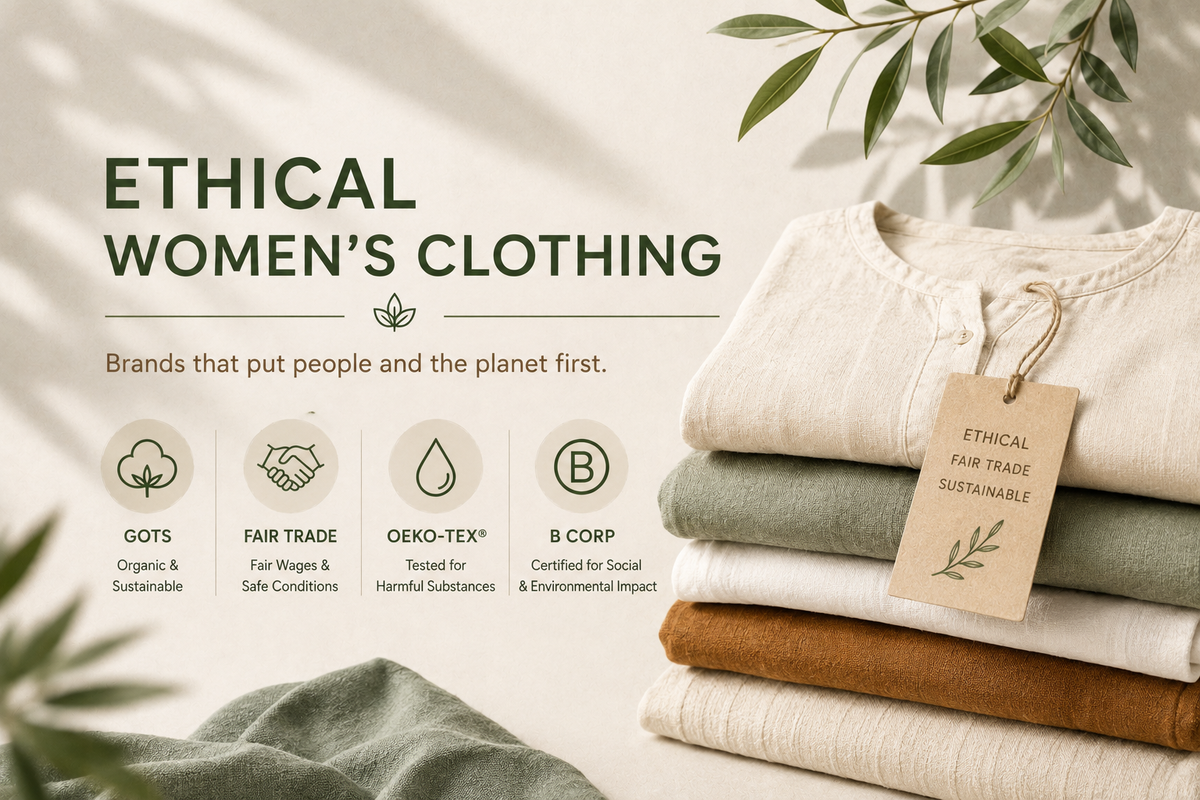
- GOTS (Global Organic Textile Standard) — at least 70% certified organic fiber content plus environmental and social production standards.
- Fair Trade — verifies fair wages and safe working conditions specifically, independent of material sourcing.
- OEKO-TEX Standard 100 — confirms the finished fabric was tested for harmful substances (a chemical-safety check, not a labor or organic-sourcing one — see our organic cotton breakdown for how these certifications differ).
- B Corp — broader business-practices certification covering social and environmental performance company-wide, externally audited.
None of these four is redundant with the others — a brand carrying multiple is disclosing more, not repeating the same claim four times.
What these brands have in common, and where the gap is
Same pattern as the men's brand list: specificity beats vague adjectives every time, across every brand here. None of these four are UAE-based or built around UAE heat performance specifically — worth pairing this list with our UAE women's shopping guide if regional fit and climate performance matter as much as the ethical sourcing itself.
Where Okapi sits, honestly, in this conversation
We don't currently hold Fair Trade or B Corp certification — we're a small UAE brand still building toward that level of documented, audited transparency. What we can say accurately right now: our manufacturing partnerships are disclosed where we can verify them, and we're working toward the kind of formal certification the brands above have already secured. If certified ethical sourcing at this level is the priority right now, the brands above have a longer, more documented track record than we currently do.

Frequently asked questions
What makes a women's clothing brand genuinely "ethical" rather than just marketed that way?
Specific, verifiable practices — Fair Trade or B Corp certification, disclosed factory locations, or a clearly stated labor-focused mission — rather than the unregulated word "ethical" alone.
Is GOTS certification the same thing as Fair Trade certification?
No — GOTS focuses primarily on organic material content and environmental production standards (with some labor criteria included), while Fair Trade focuses specifically and primarily on wages and working conditions.
Are ethical women's clothing brands always expensive?
Not universally — Pact specifically targets an accessible price point while maintaining Fair Trade certification, similar to its men's line.
Do any of these specifically address UAE climate performance?
Not specifically — their ethical certifications are well-documented, but none were built around UAE heat performance the way brands covered in our UAE shopping guide are.