

From Coffee Grounds to Clothing: How Your Morning Coffee Can Get a Second Life
Coffee.
Brew.
Drink.
Discard.
Repeat.
For most of us, that's the complete lifecycle.
But what if the story didn't have to end after the cup?
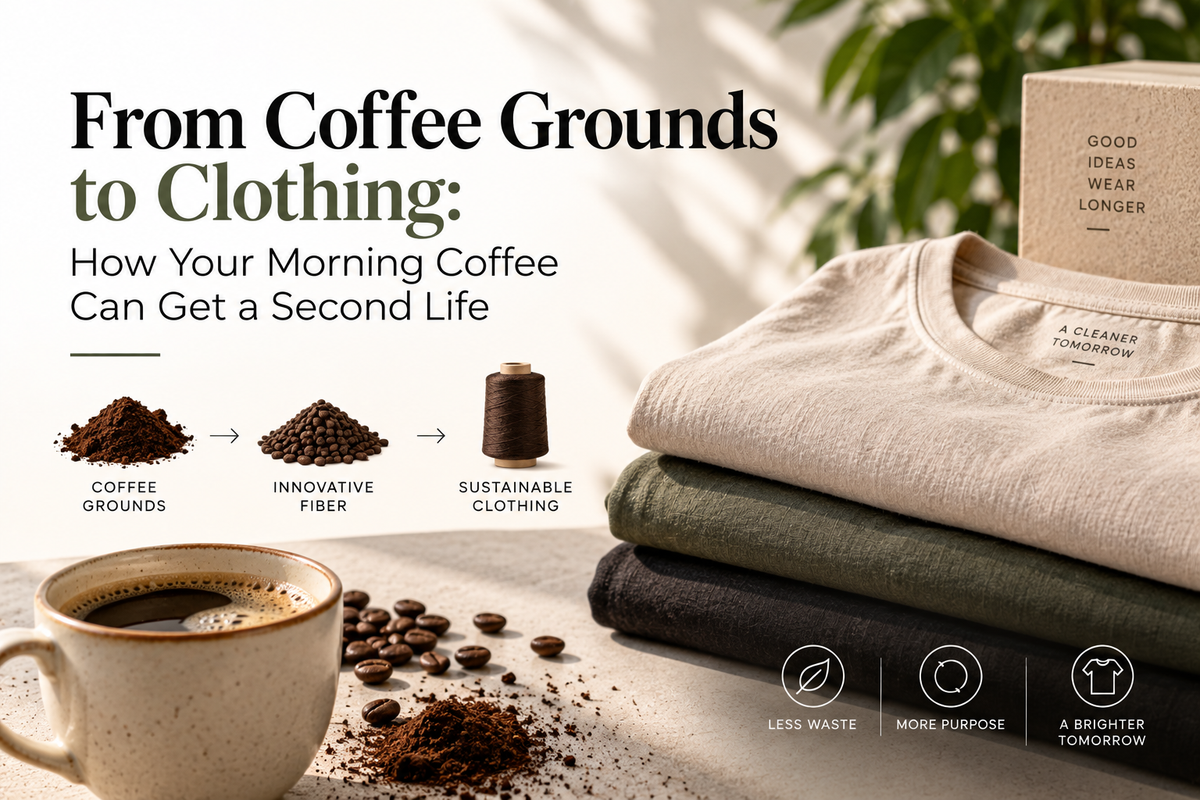
Step 1: Coffee Is Brewed
The story begins exactly where you'd expect.
Coffee grounds are used to prepare the drink millions of people start their day with.
After brewing, spent grounds remain.
Traditionally, those grounds have little connection to fashion.
Textile innovation changed that conversation.
Step 2: Spent Coffee Grounds Are Collected
Instead of viewing the used grounds only as a discarded by-product, they can be collected for additional processing.
This reflects a broader design principle:
Before asking for another virgin resource, ask whether an existing material could have another use.
Step 3: The Coffee-Derived Material Is Processed
Raw wet coffee grounds cannot simply be mixed into a T-shirt.

They require specialized processing.
Depending on the textile technology, processed coffee-derived material can then become an input used within fiber or yarn production.
Step 4: Textile Fiber Becomes Fabric
The resulting textile system can be spun, knitted or otherwise manufactured into fabric depending on its construction.
And this is where the story starts looking surprisingly ordinary.
Because the finished material doesn't need to look like an experiment.
It can become a polo.
A T-shirt.
A tank.
A pair of socks.
Step 5: Fabric Becomes Fashion
This is the stage we care deeply about at Okapi.
A fascinating raw-material story isn't enough.
People don't buy textile technology to hang in a museum.
They buy clothes to wear.
So the design has to stand independently.
Clean lines.
Contemporary colors.
Comfortable silhouettes.
Everyday versatility.
The coffee story should be a discovery—not a compromise.
Does the Clothing Smell Like Coffee?
No coffee shop required.
Processed coffee-derived textile material isn't intended to make clothing smell like your morning brew.
"Coffee clothing" refers to the material story and textile technology.
Is It Really Made From Coffee?
This needs careful wording.
Coffee-derived material can form part of the textile system.
That does not necessarily mean the entire garment is made exclusively from coffee grounds.
The exact composition should always be checked on the individual product.
Transparency matters more than a dramatic headline.
Why Does This Matter?
Because coffee is only one example of a much bigger idea.
What else are we overlooking?
Lotus stems?
Banana plants?
Pineapple leaves?
Other agricultural by-products?
Recycled resources?
The materials around us may contain possibilities we haven't fully explored yet.
Frequently Asked Questions
Can coffee grounds really be turned into clothing?
Processed material derived from spent coffee grounds can be incorporated into certain textile fiber and fabric technologies.
Are clothes made entirely from coffee?
Typically not. Coffee-derived material is generally part of a larger textile composition.
Does coffee clothing smell like coffee?
It is not intended to smell like brewed coffee because the grounds undergo processing before textile incorporation.
Why use spent coffee grounds?
Using by-products as inputs for other applications can create additional value from materials that have already served their original purpose.
Where can I find coffee clothing?
Okapi Lifestyle explores coffee-derived textile technology through its Café collection of contemporary everyday apparel.
Coffee Was Only the Beginning
We didn't want to create clothing that merely talked about nature.
We wanted to explore what nature and textile technology could do together.
So next time you finish your morning coffee, remember:
The drink may be finished.
The material story might not be.
Drink Coffee. Dress Coffee.
Okapi Lifestyle — Nature in Every Thread.