

What Does 'Sustainable Fashion' Actually Mean? A No-BS Guide
Short answer: Sustainable fashion means clothing made with lower environmental impact, fair labor practices, and genuine durability — all three together, not just one. In the UAE specifically, durability carries extra weight, because Dubai's heat and humidity wear out cheap fabric fast, so a "sustainable" garment that falls apart in three months isn't actually sustainable here, whatever the tag says.
Somebody asked me this at a market stall in Dubai a few weeks back — "so what actually makes your stuff sustainable, or is that just a word on the label now?" Fair question. Honestly, more people in the UAE should ask it before they buy, because this market gets targeted with the same vague "eco" labeling as everywhere else, just with less local scrutiny.
Here's the uncomfortable part: roughly 60% of sustainability claims made by fashion brands are misleading or can't actually be backed up. That's not a fringe number. That's most of the "eco" labels you've walked past this year, in Dubai Mall or on a Shein order. The word has basically been drained of meaning by overuse — which is exactly why it's worth breaking down properly, once, instead of nodding along every time a hangtag says "conscious."
The actual definition, stripped of marketing
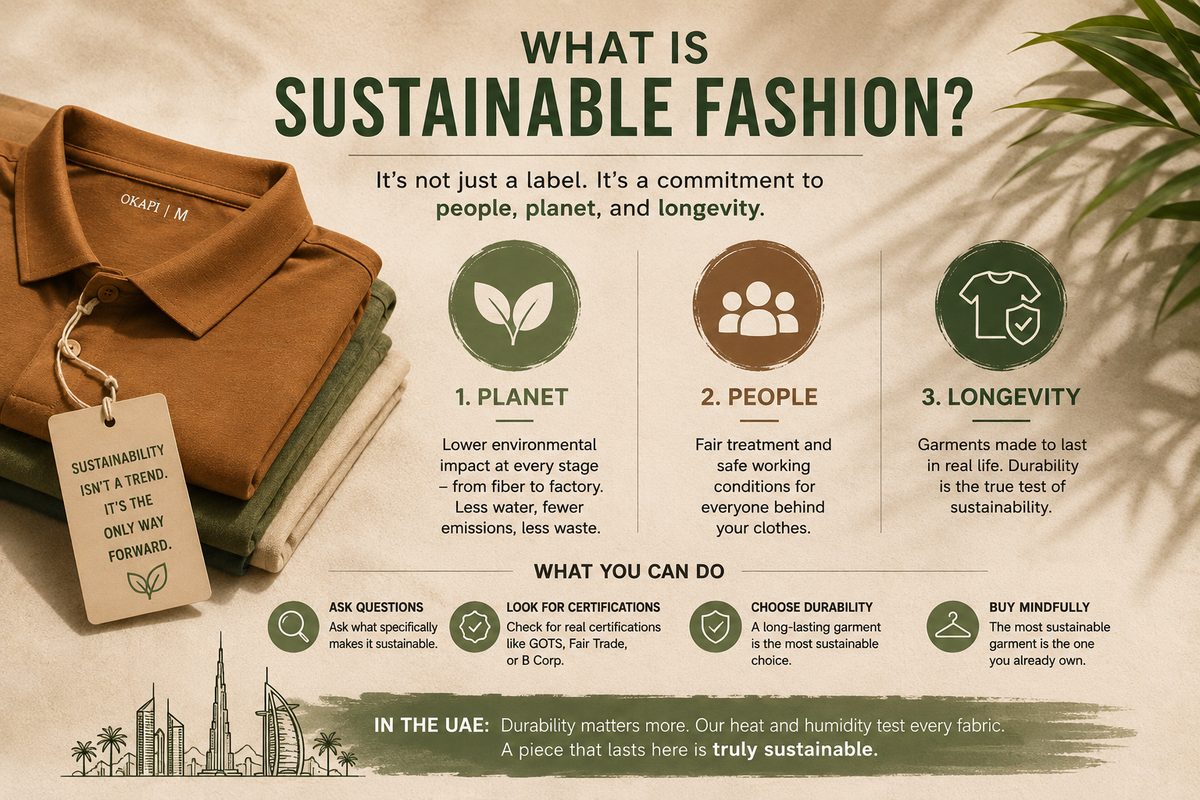
Sustainable fashion is clothing where lower environmental impact, fair labor, and real durability all hold true at once — not just one of the three. Cut through the noise and it comes down to:
- Lower environmental impact — less water, fewer emissions, less waste at every stage from fiber to factory.
- Fair treatment of the people making it — wages, safety, no exploitation buried three suppliers deep.
- A garment built to actually last, not fall apart by the fifth wash.
A brand doing only one of these and shouting about it isn't sustainable — it's doing marketing with a green filter on. Fashion sustainability only really works when environmental impact, fair labor, and garment longevity are addressed together rather than any one being treated as sufficient on its own.
Why the word stopped meaning anything
No, "eco-friendly" and "conscious" aren't legally regulated terms anywhere yet — not in the EU, not in the UAE. "Eco," "conscious," "green" — none of these are regulated terms. A brand can print any of them on a swing tag with zero third-party check. That's not a loophole, that's just... the current rule. Or rather, it was.
Here's the part most articles on this topic haven't caught up to yet: the EU is rolling out a ban on unverified generic green claims starting September 2026, meaning brands selling into Europe will soon have to prove "eco-friendly" with actual evidence, not just print it. It's a genuinely new development, and it's a signal of where the whole industry is being pushed — toward documentation over declaration. If you're shopping today, you can basically pre-empt that regulation yourself by applying the same standard: don't trust an unverified label.
The certifications that actually mean something
Not every claim is empty. A few labels represent real, audited standards rather than marketing copy:
- GOTS (Global Organic Textile Standard) — covers organic fiber content and processing, independently audited.
- Fair Trade — focused specifically on labor conditions and wages, not materials.
- B Corp — a broader business-practices certification, not fashion-specific, but increasingly used by brands to signal accountability beyond the product itself.
None of these are perfect and none cover everything. But they involve someone outside the brand actually checking. That's the line between a claim and a fact.
The part nobody selling you clothes wants to say out loud
The single most sustainable garment is the one you already own. Not the new "eco" version of it. The most genuinely sustainable clothing is what's already in your closet and continues to be worn — buying a "greener" replacement for something that still works is, functionally, still just buying more stuff.
This is also where durability quietly becomes a sustainability metric, not just a quality one. A piece worn 40 times costs less per wear and creates less waste than a cheap one worn twice and binned. Some larger brands are catching onto this — Patagonia's repair-and-resale program and Levi's secondhand marketplace both treat keeping a garment in circulation longer as the actual goal, not an afterthought.
Why this matters more in Dubai than almost anywhere else
Heat and humidity in the UAE accelerate fabric breakdown, so durability isn't optional here — it's the actual sustainability test. A cotton tee that's fine for a mild European climate can pill, yellow, or lose shape within months of daily 40°C wear and AC-to-outdoor temperature swings. That's not a UAE-specific myth — it's just physics: heat speeds up fiber degradation, and frequent washing (which UAE heat forces on you) speeds it up further.
This is also why "sustainable" claims need more scrutiny here, not less. A garment shipped in from a European "eco" brand that wasn't designed for Gulf conditions may need replacing twice as fast as one built for it — which quietly cancels out whatever sustainability claim got it here in the first place.
So what should you actually do with this?
Practically, before you buy something marketed as sustainable:
- Ask what specifically makes it sustainable — a material, a labor practice, a certification. If the answer is vague, that's your answer.
- Check for a real certification, not just a word. No badge, no audit trail — treat the claim as marketing until proven otherwise.
- Weigh durability as seriously as the material story. A "sustainable" fabric in a garment that falls apart in six months isn't sustainable, it's just better-marketed waste.
- Consider whether you need it at all. Not a guilt trip — just the most honest question in the whole conversation.
We work with coffee-ground fabric and lotus fiber at Okapi specifically because they hold up in UAE heat and don't fall apart in eight months of daily wear — durability was never a separate conversation from sustainability for us, it was the same one. But that's true of any brand actually doing this seriously, not just us. The test isn't the material name on the tag. It's whether the whole picture — impact, labor, and lifespan — actually adds up when you look closely.
Frequently asked questions
What is sustainable fashion, in one sentence?
Clothing made with lower environmental impact, fair labor conditions, and genuine durability, all three holding true together — not just one used as a marketing claim.
Is sustainable fashion more expensive in the UAE?
Often yes upfront, but not necessarily per wear. A durable piece that survives Dubai's heat and frequent washing for two years costs less per wear than a cheap one replaced three times over the same period.
How can I tell if a UAE clothing brand's sustainability claim is real?
Look for a specific, named material or process (not just the word "eco"), a third-party certification like GOTS or Fair Trade, and evidence the garment is actually built for local heat and humidity — not just imported with a green label attached.
Does "eco-friendly" mean anything legally in the UAE?
No — like most markets outside the EU, the UAE has no legal definition for "eco-friendly" or "conscious" on clothing labels yet, so the term alone guarantees nothing without a real certification behind it.