


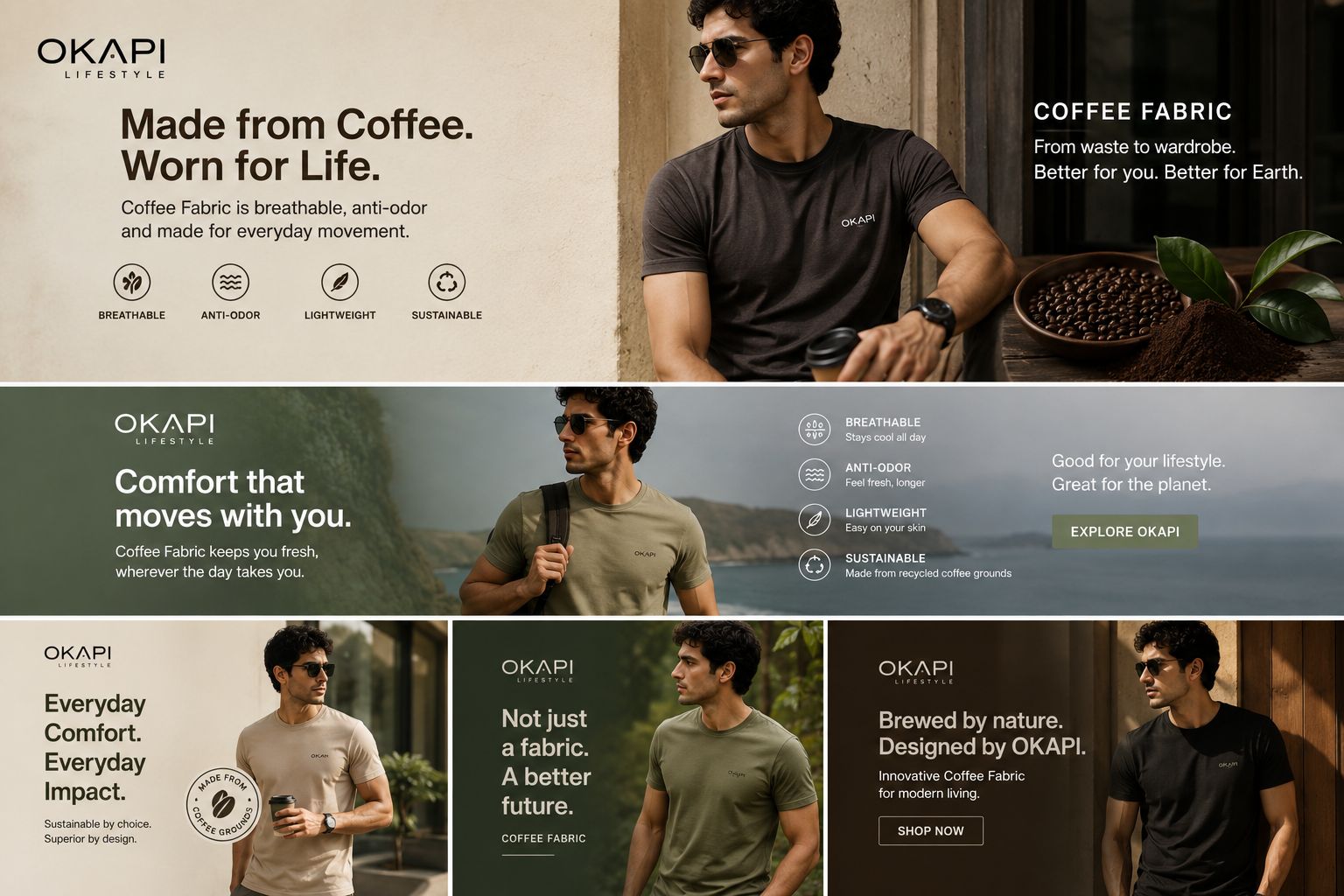
The Shirt That Started as Your Morning Coffee
Most people never think about what happens to their coffee after it is brewed.
The cup gets finished. The grounds get thrown out. That is usually the end of the story.
But in textile innovation, that is exactly where a new story begins.
At OKAPI Lifestyle, the coffee in your morning cup is the same raw material behind our Café Polo — a performance-first, everyday shirt made partly from recycled coffee grounds. It sounds like a clever idea on the surface. But the more you understand how it works, the more it makes complete sense.
What Coffee Fabric Actually Is (And What It Is Not)
Before anything else, let us clear something up.
Coffee fabric clothing does not smell like an espresso. It does not look brown by default. And it is not a gimmick designed to sound interesting on a label.
Coffee fabric is a genuine textile innovation. Used coffee grounds — the kind discarded daily in homes, cafés, and offices — are collected, cleaned, and processed into a material that can be blended into yarn. That yarn becomes fabric. That fabric becomes clothing.
The end result is a garment that feels soft, breathes well, and handles the kind of daily wear most clothing struggles with. The coffee origin is part of what gives the fabric its performance character — not a marketing afterthought.

Why Coffee Grounds Make Better Fabric Than You Would Expect
Here is the part that surprises most people.
Used coffee grounds have a naturally porous structure at the microscopic level. When processed into fibre, that structure does real work inside the garment.
It absorbs moisture fast. The fabric pulls sweat away from skin quickly, which matters when you are moving through a warm afternoon, commuting, or spending hours in and out of air conditioning.
It neutralises odour naturally. This is the performance feature people notice most after wearing it. The fibre's hollow structure traps odour molecules rather than letting them linger. One wash, and the fabric resets. Daily freshness without heavy chemistry.
It blocks UV rays. Coffee fibre provides meaningful protection against ultraviolet exposure — genuinely useful in high-sun environments like the UAE, where outdoor exposure is a daily reality rather than an occasional concern.
It holds its shape. Wrinkle resistance comes with the territory. The fabric stays smooth through long days and repeated washes without losing structure.
None of these are claims that require a technical background to understand or experience. You can feel most of them the first time you wear it.
The Journey From Grounds to Garment
The process is straightforward, even if the science behind it is not.

Used coffee grounds are collected from commercial and consumer sources. The grounds are cleaned and treated to remove oils and impurities. They are then processed into a material that can be combined with other sustainable fibres — including recycled plastic — to form a stable, wearable yarn.
That yarn is woven or knitted into fabric. The fabric goes through quality and performance testing. Then it becomes a garment.
What makes this interesting is not just the innovation. It is what the innovation replaces. Every kilogram of coffee-based fibre used in clothing is one less kilogram of virgin synthetic or resource-heavy natural material needed. Coffee waste, which would otherwise go to landfill, becomes part of a garment worn every day. That is circularity in the most practical sense of the word.
It Starts Right Here

Every pair of used coffee grounds you discard is, in a sense, a fabric waiting to be made. The raw material is already there — billions of cups worth of it, every single day. The question is only what happens to it next.
Why This Matters for How You Dress Every Day
Sustainability in fashion has a perception problem.
For years, eco-conscious clothing meant compromise — rougher textures, dull colours, boxy cuts, or a general feeling that you were wearing something designed more for a statement than for actual living.
OKAPI's position on this is direct: that trade-off is outdated.
The Café Polo is not a sustainable shirt that happens to look decent. It is a well-designed everyday polo that happens to be made from a smarter material. The performance is why you would wear it daily. The material origin is why you feel good about it.
That order matters. When the garment earns its place in a wardrobe on its own merit — fit, feel, versatility — the sustainability story becomes a bonus, not a justification.
Who Actually Wears Coffee Fabric Clothing
Honestly? People who are tired of choosing between comfort and quality.
Someone who travels regularly and needs a polo that packs light, stays fresh through a long travel day, and still looks put-together at the other end. Someone who moves between an air-conditioned office and the heat outside and needs a shirt that adjusts to both. Someone who shops with an eye on material quality, not trend cycles.
Coffee fabric clothing sits naturally in that space. It is not gymwear. It is not formalwear. It is the middle ground most wardrobes actually need — elevated basics that work across the full range of a modern day.
The OKAPI Café Collection
The Café Collection is built around one central idea: that everyday clothing should carry a better story without asking you to sacrifice anything to get it.
The collection draws on warm, earthy tones that reflect the origin material — not in a literal way, but in an understated palette that feels considered and calm. Each piece prioritises breathability, softness, and a clean silhouette over trend-chasing.
The Café Polo is the anchor of the range. It is designed to be worn more than once a week, without the fabric suffering for it. Odour resistance, shape retention, and quick drying make it genuinely suitable for high-frequency use — which is the only test that matters for a daily essential.
A Few Things Worth Knowing Before You Buy
It washes easily. Coffee fabric does not require special care. Standard machine wash preserves the fabric's performance properties over time.
The colours hold. The fabric takes dye well, which means the earthy, warm tones in the Café Collection maintain their depth after repeated washing.
It pairs with almost everything. Because the pieces are designed around a neutral palette and clean lines, they sit naturally alongside both casual and smart-casual wardrobes.
The comfort is immediate. This is not fabric that needs a break-in period. Most people notice the softness and breathability from the first wear.
The Bigger Picture
Fashion is one of the most resource-intensive industries on the planet. That is a well-documented fact and an ongoing problem.
But the solution is not to stop buying clothing. It is to buy clothing that is made more thoughtfully — from materials that take less from the environment, last longer in practice, and carry a story you can actually stand behind.
Coffee fabric is one small but meaningful part of that shift. It uses something that already exists — and would otherwise be discarded — and turns it into something functional and long-lasting.
At OKAPI, we think that is exactly what modern design should be doing. Not dramatic gestures. Just better decisions, repeated daily.
Drink coffee. Dress coffee.
