

Ethical vs Sustainable Clothing: What's Actually the Difference
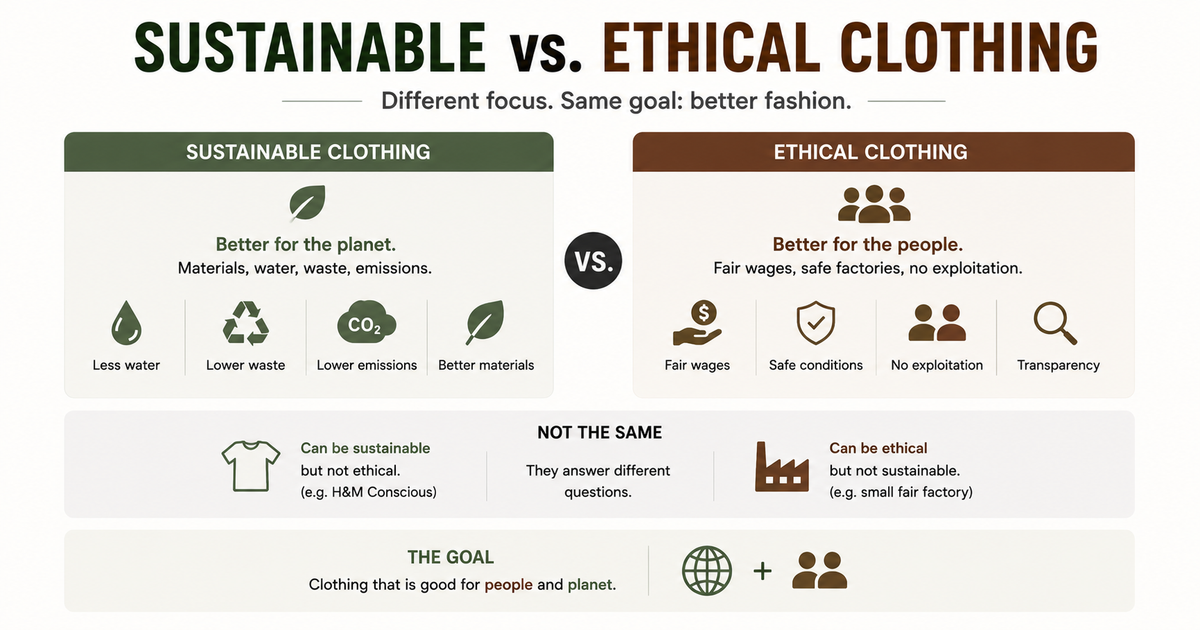
Short answer: Sustainable clothing is about the planet — materials, water, waste, emissions. Ethical clothing is about the people who made it — fair wages, safe factories, no exploitation. A brand can be one without being the other, and plenty are. They get used as interchangeable buzzwords, but they're answering two completely different questions.
Here's a real example that makes the split obvious: H&M's Conscious Collection markets itself on sustainable materials, but has faced ongoing criticism over factory labor conditions in its supply chain — sustainable-leaning, not necessarily ethical. Flip it around and you can find a brand paying fair wages in a small transparent factory that still uses conventional, resource-heavy cotton — ethical, not particularly sustainable. Neither is lying exactly. They're just answering different questions and letting you assume it's the same one.
The actual difference, side by side
| Sustainable | Ethical | |
|---|---|---|
| Main concern | Environmental impact | Human treatment |
| Looks at | Materials, water use, emissions, waste, durability | Wages, factory safety, worker rights, transparency |
| Typical proof | GOTS, OEKO-TEX, recycled content certifications | Fair Trade, SA8000, factory audits |
| Can exist without the other? | Yes — eco-friendly material made by underpaid workers | Yes — fair wages, but using conventional resource-heavy cotton |
Why the environmental side gets so much attention
The numbers here are genuinely stark, which is probably why "sustainable" dominates the marketing conversation more than "ethical" does. A single cotton t-shirt can take up to 2,700 liters of water to produce, and the fashion industry as a whole contributes around 8% of global greenhouse gas emissions — comparable to entire countries' output. Those are the kind of headline numbers that make for an easy marketing story: "we use less water," "we use recycled fiber." Concrete, measurable, easy to put on a hangtag.
Why the human side gets talked about less
Labor conditions are harder to market because they're harder to verify from the outside — there's no simple number to print. But the scale of the problem is arguably worse: an estimated 2% of fashion industry workers worldwide are paid a livable wage. That's not a rounding error, that's the overwhelming majority of the people making the clothes on shelves globally.
This is also why "ethical" claims deserve more scrutiny than "sustainable" ones, not less — a brand can point to a specific recycled fabric percentage, but "we treat our workers fairly" is much easier to say without evidence behind it.
What this looks like from the UAE
The UAE imports the overwhelming majority of its clothing, which means most of what's sold here was made somewhere else, under labor conditions most shoppers never see and most brands don't disclose. That's not a UAE-specific failing — it's true of nearly every clothing market that isn't also a major manufacturing base. But it does mean asking "who made this, and how" is a genuinely useful question to bring into a UAE shopping decision, not just a Western ethical-fashion talking point.
Practically: a brand that's transparent about where it manufactures — names the country, ideally the factory — is already ahead of one that just says "ethically made" with no specifics.
How to actually check both, not just one
- For sustainability: look for a named material (not just "eco-fabric"), and a real certification like GOTS or OEKO-TEX if it's meant to be organic or non-toxic.
- For ethics: look for a named country of manufacture at minimum, ideally a named factory, and certifications like Fair Trade or SA8000 if the brand claims fair labor.
- Red flag either way: a brand that talks about one loudly and stays completely silent on the other. Genuine brands usually have something to say about both, even if neither is perfect yet.
At Okapi, our coffee-ground and lotus fiber materials are the sustainability side of the story — but we're upfront that being a small UAE brand means our supply chain transparency is still a work in progress compared to companies with a decade of audits behind them. That's not a claim of moral superiority, it's just where we actually are, which is more useful to you than a vague promise either way.
Frequently asked questions
Can a brand be sustainable but not ethical?
Yes — this is actually common. A brand can use recycled or organic materials while manufacturing in factories with poor labor conditions, since "sustainable" certifications typically don't audit labor practices at all.
Can a brand be ethical but not sustainable?
Also yes. A small factory can pay fair, transparent wages while still using conventional cotton or polyester with a high environmental footprint — ethical sourcing doesn't automatically mean eco-friendly materials.
Which certification covers both?
None fully does, which is exactly the gap. GOTS focuses on organic material standards with some labor criteria; Fair Trade focuses on labor with minimal material requirements. A brand claiming both usually needs to show two separate certifications, not one.
Is one more important than the other?
Not really — they answer different harms. Prioritizing one over the other depends on what you personally care about most, but a brand that's genuinely responsible usually has a real answer for both questions, not just the one that's easier to market.