

Slow Fashion vs Fast Fashion: What's the Real Difference
Short answer: Fast fashion is built for speed — new designs hit shelves in weeks, priced to be worn a handful of times and replaced. Slow fashion is built for lifespan — fewer pieces, made to last years, at a higher upfront cost that works out cheaper over time. The difference isn't really about style. It's about what happens to the garment after you buy it.
I used to think "slow fashion" was just a nicer way of saying "expensive." Then I actually did the math on a fast-fashion tee I'd replaced four times in two years versus a decent one I've had for three and is still fine. The slow one wasn't just better made — it was cheaper, once you count what I actually spent.
What "fast" actually means, mechanically
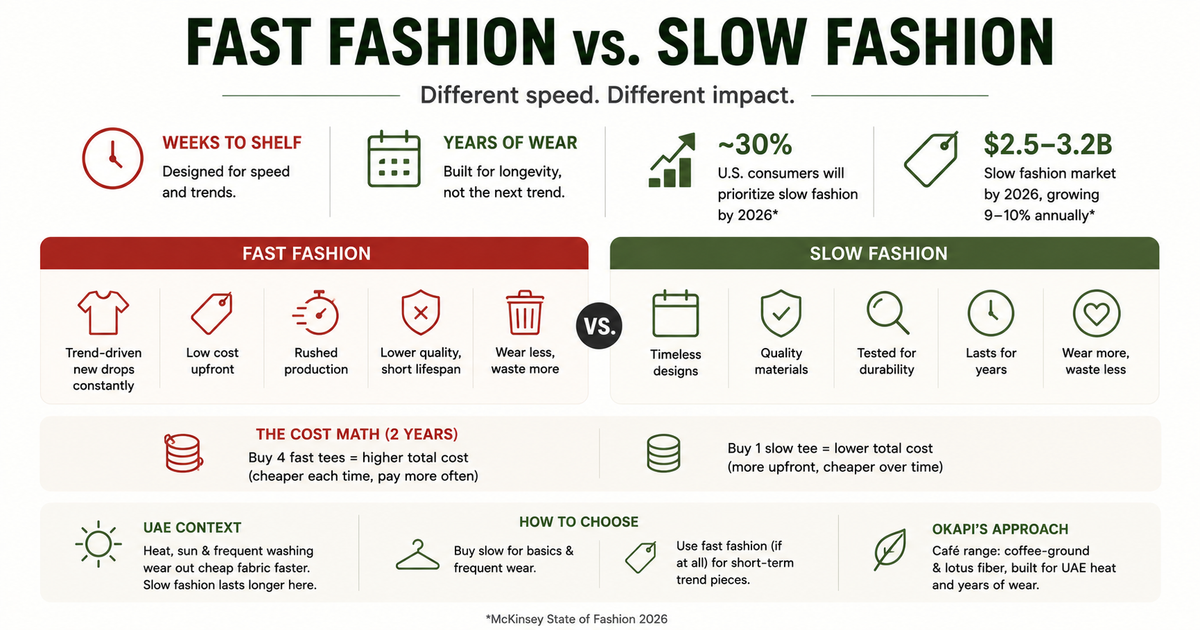
Fast fashion brands can go from sketch to store shelf in a few weeks. That speed is the entire business model — it lets brands chase whatever trend is peaking on social media right now and get product out before the trend dies. The tradeoff is built in: clothes made to be trend-relevant for one season aren't usually made to survive past it. Cheap materials, rushed construction, low prices — all three come from the same decision to prioritize speed.
What "slow" actually means, mechanically
Slow fashion brands take months, not weeks, because durability testing and quality sourcing take time you can't compress. Slow fashion pieces are typically engineered for a lifespan of years rather than months, and often go through actual fabric strength and colorfastness testing before they ship — testing fast fashion largely skips because it doesn't need garments to survive that long anyway.
The number that actually surprised me
This isn't a fringe movement anymore. According to McKinsey's State of Fashion 2026 report, nearly 30% of U.S. consumers will actively prioritize slow fashion over disposable clothing by 2026 — not as a niche ethical choice, but as a real structural shift in how people shop. The slow fashion market itself is projected to reach $2.5-3.2 billion globally around the same period, growing at roughly 9-10% a year. That's not activist messaging. That's a market actually moving.
The cost math nobody explains clearly
Slow fashion usually costs 25-40% more upfront than the fast fashion equivalent. On its own, that sounds like the whole story — and most articles stop there, letting "more expensive" be the final word. It isn't. A slow fashion piece sells and stays in wardrobe rotation far longer than a fast fashion one, which is the actual point: you're not comparing two prices, you're comparing one price paid once against a smaller price paid repeatedly.
Run the numbers over two years instead of one purchase, and the fast fashion habit is usually the more expensive one — you're just paying it in installments instead of upfront, which makes it feel cheaper in the moment even when it isn't.
Where this gets complicated in the UAE specifically
Fast fashion is genuinely convenient here — malls built around it, delivery in hours, prices that make trying a new style low-stakes. That convenience is real and I'm not going to pretend it isn't. But UAE heat is also uniquely hard on cheap fabric: more sweating, more frequent washing, more sun exposure than most climates that fast fashion garments are actually tested for (which is often none at all). A fast fashion tee that might survive a year of mild-climate wear can degrade in months here. That shortens the "cheap in the moment" math even further than it already is elsewhere.
So which one should you actually buy?
Realistically — a mix, and slow fashion advocates who tell you to buy zero fast fashion ever again are usually overselling it. But a useful rule: buy slow for anything you'll wear weekly (basics, workwear, anything that touches UAE heat constantly), and reserve fast fashion, if you use it at all, for genuinely trend-specific pieces you know you'll retire fast anyway. That's not a purity test, it's just matching the garment's lifespan to how you'll actually use it.
We build the Café range at Okapi around exactly this logic — coffee-ground and lotus fiber pieces engineered specifically to hold up under UAE heat and frequent washing, meant to be worn for years of rotation rather than one season. Not because slow fashion is a moral high ground, but because it's the only version of "sustainable" that actually survives contact with a Dubai summer.
Frequently asked questions
Is slow fashion always more expensive?
Upfront, usually yes — typically 25-40% more than a fast fashion equivalent. Per-wear, over its full lifespan, it's often cheaper, since it survives years of use instead of a handful of washes.
Can fast fashion ever be a reasonable choice?
Yes, for genuinely short-lifespan needs — a one-off event outfit or a fast-moving trend piece you know you won't wear long-term. The problem isn't fast fashion existing, it's using it for things you'll actually wear for years.
Does slow fashion mean handmade or artisanal only?
No — it refers to production philosophy (fewer collections, durability testing, quality materials) rather than a specific manufacturing method. A slow fashion brand can still use modern manufacturing, just built around longevity rather than speed.
Why does UAE heat matter to this choice specifically?
Cheap fabric degrades faster under high heat, sun exposure, and the more frequent washing UAE weather forces on you — so the already-weak cost logic of fast fashion breaks down even faster here than in milder climates.