

Fast Fashion's Environmental Cost: What the Numbers Actually Say
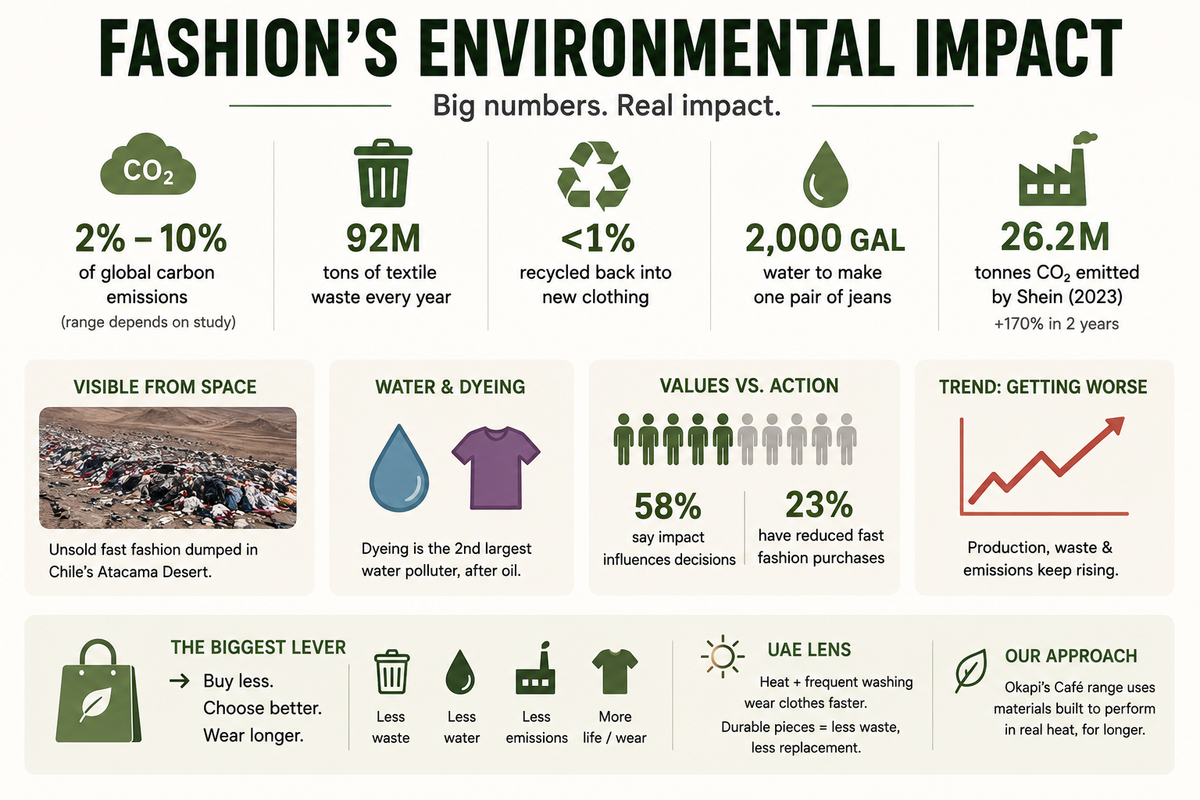
Short answer: Fashion accounts for somewhere between 2% and 10% of global carbon emissions depending on which study you read, generates roughly 92 million tons of textile waste a year, and less than 1% of that waste actually gets recycled back into new clothing. The range in the emissions number isn't spin — it's genuinely disputed depending on what's counted. But even the low end of that range is a serious number for one industry.
I'll be honest about something most "shocking fashion stats" posts won't tell you: the numbers don't all agree. Some studies say fashion is responsible for 10% of global emissions — more than international flights and shipping combined. Others, using narrower methodology, put it at 2-4%. Both figures get cited constantly, often without anyone explaining why they differ. So here's the honest version: the true number is contested, but every credible study puts fashion's footprint somewhere in the range of "a major global industry's worth of emissions," not a rounding error.
The waste number that's harder to argue with
Textile waste is more consistently measured than emissions, and it's not pretty. An estimated 92 million tons of textiles are discarded globally every year. Of what's thrown away, less than 1% actually gets recycled into new clothing — most "recycled" textile programs are actually downcycling into insulation or rags, not making new garments. The recycling rate has gone in the wrong direction over time, not the right one: US textile recycling was around 30% in the 1960s-90s and has since collapsed.
A place you can actually see this from space
This is the detail that made the abstraction real for me: satellite imagery has confirmed that a mountain of discarded clothing in Chile's Atacama Desert — much of it unsold inventory from the US, Europe, and Asia, price tags still attached — is large enough to be visible from space. That's not a metaphor. That's an actual satellite photo of unsold fast fashion, dumped in a desert, big enough to see from orbit.
Water, dyeing, and the part that's invisible at checkout
Producing a single pair of jeans can take around 2,000 gallons of water; a cotton shirt around 700. Textile dyeing is the second-largest polluter of water globally, behind only oil. None of this shows up on a price tag or a receipt — the environmental cost is paid somewhere upstream, invisible to the person at checkout, which is a big part of why fast fashion can be priced the way it is.
The company that's become the case study
Shein's carbon emissions hit 26.2 million metric tonnes in a recent reporting year — up 170% in just two years. If Shein's emissions were a country's total output, it would rank around the 100th-biggest emitter in the world. That's not a hypothetical about "the industry" in the abstract. That's one company's actual trajectory, and it's the clearest evidence that the ultra-fast fashion model isn't slowing down on its own.

The gap between what people say and what people buy
Here's the uncomfortable part for shoppers, not just brands: 58% of people say environmental impact influences their clothing decisions. Only 23% have actually, materially reduced their fast fashion purchases. That's a real and fairly large gap between stated values and actual behavior — worth sitting with honestly rather than only pointing at brands.
What this means practically, not just statistically
None of this is an argument that every fast fashion purchase is a personal moral failure — that framing tends to just make people defensive and change nothing. The more useful takeaway is simpler: buying fewer, longer-lasting pieces is the single lever that moves every number in this article at once — less waste, less water, less production volume, less emissions per year of wear. It's the one piece of sustainable fashion advice that isn't contested by any study, regardless of methodology.
In the UAE specifically, that argument gets stronger, not weaker — heat and frequent washing already shorten a garment's working life here, so buying pieces built to survive that environment does double duty: fewer replacement purchases for you, less waste at the industry level. It's the same reason we build Okapi's Café range around materials tested to hold up under exactly those conditions, rather than ones optimized for a one-season sell-through.
Frequently asked questions
What percentage of global emissions does fashion actually cause?
Studies range from 2% to 10% depending on methodology and what's included in the calculation. There's no single agreed-upon figure, but every credible estimate places fashion among the more carbon-intensive global industries.
How much of discarded clothing actually gets recycled?
Less than 1% is recycled into new garments. Most textile "recycling" is downcycling into rags, insulation, or other lower-value materials, not new clothing.
Is fast fashion's environmental impact getting better or worse?
Worse by most measures — global textile production and fashion-related emissions have both continued rising in recent years despite growing sustainability marketing across the industry.
Does buying less really make a measurable difference?
Yes — extending a garment's useful life is one of the few interventions that reduces every major environmental cost simultaneously (production volume, waste, water use, emissions per year of wear), regardless of which underlying study's numbers you trust most.