

What Is Greenwashing and How to Spot It on a Clothing Tag
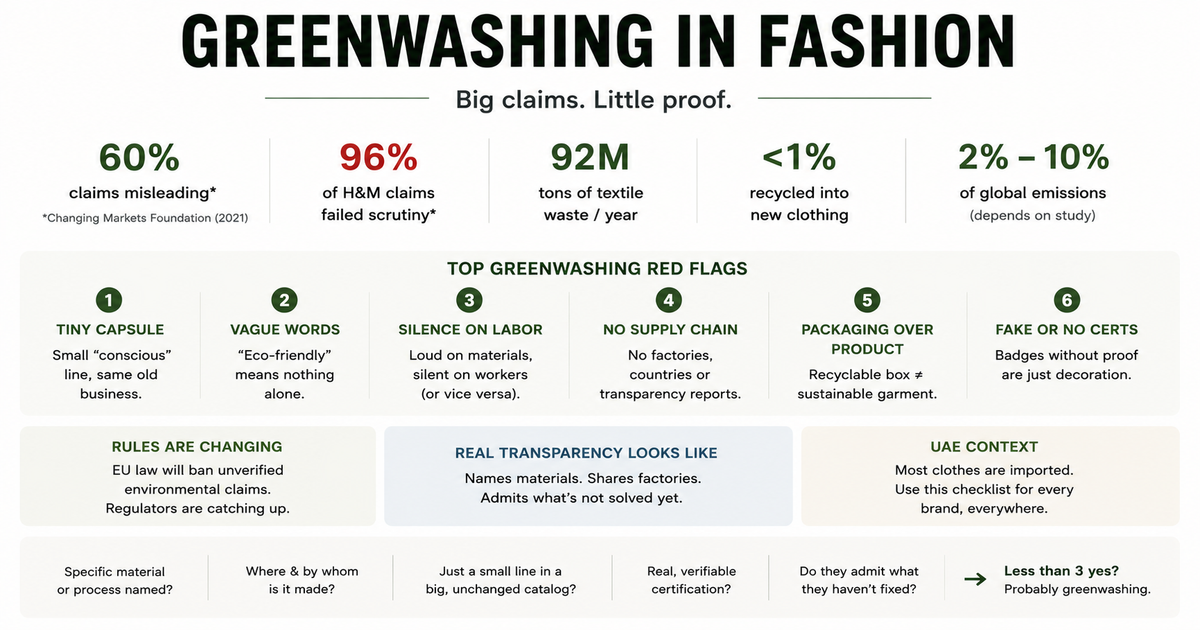
Short answer: Greenwashing is when a brand markets itself as sustainable without the practices to back it up — vague words, no evidence, no verification. In fashion specifically, it's the single most common trick in the industry, and it's not rare or occasional. A 2021 investigation by the Changing Markets Foundation found that 60% of sustainability claims across major fashion brands were misleading — and one brand, H&M, had 96% of its claims fail to hold up under scrutiny.
Ninety-six percent. Not "some of their claims were a stretch." Almost all of them.
The actual red flags, not vague ones
Most greenwashing guides give you the same three vague warnings. Here are the specific, checkable ones:
- A tiny "conscious" capsule inside an otherwise unchanged fast-fashion catalog. If 95% of a brand's output is business as usual and 5% gets the green label, the label is marketing, not a business model.
- Vague adjectives with no specific claim behind them. "Eco-friendly," "planet-kind," "conscious" — none of these mean anything on their own. A real claim names a material, a percentage, or a process.
- Silence on labor while loudly promoting materials (or the reverse). A brand that only ever talks about fabric and never mentions factories or workers is telling you exactly what it doesn't want you to ask about.
- No published supply chain data. Real transparency looks like a Fashion Transparency Index-style report, named suppliers, named countries. If a brand won't say where or by whom something was made, that's the answer.
- Recyclable packaging as the headline, while the garment itself is synthetic and sheds microplastics. This is a specific, common trick — solving the visible, easy problem (the box) while ignoring the actual product.
- Certifications that don't exist or can't be verified. Some brands invent badge-like graphics that look official but aren't tied to any real certifying body. If you can't find the certification's name on an independent registry, it's decoration.
Why this is getting harder to get away with
Regulators are catching up, finally. The EU's Green Claims Directive is moving toward banning unverified environmental claims outright, and enforcement bodies are increasingly pursuing brands over specific claims rather than letting the industry self-police. That's a real shift — for years, "eco-friendly" carried zero legal weight anywhere, and brands knew it.
What genuine transparency actually looks like
The brands that pass scrutiny tend to share a pattern: they name their exact materials rather than category words, they name their manufacturing location and often the specific facility, and — this is the part greenwashers skip — they admit what they haven't solved yet. No brand is perfectly sustainable. A brand claiming otherwise is telling you it's either lying or hasn't looked closely at its own supply chain.
Applying this in the UAE
Most clothing sold in the UAE is imported, which means most sustainability claims you'll see on a tag here were written for a market you're not standing in, by a brand whose supply chain you can't easily verify from Dubai. That's not a reason for extra suspicion specifically toward international brands — it's a reason to apply the same checklist regardless of where the brand is from, rather than assuming a bigger or more established name is automatically more truthful. Size and greenwashing rate aren't inversely related — H&M's 96% failure rate is proof of that.
At Okapi, this is exactly why we try to be specific rather than vague: coffee-ground fabric, lotus fiber, named and explainable, not just "eco-conscious." We're a small brand and don't have a decade of third-party audits behind us yet — that's a real limitation, not something we're going to pretend isn't true. The point of this checklist isn't to make you distrust every brand including us. It's to make vague claims — from anyone — stop working on you.
The 60-second checklist
Before trusting a sustainability claim, ask:
- Is there a specific material or process named, or just an adjective?
- Does the brand say where and by whom the item was made?
- Is the "sustainable" line a small fraction of a much larger, unchanged catalog?
- Is there a real, verifiable certification — or a badge that just looks official?
- Does the brand ever admit what it hasn't fixed yet?
If you can't answer at least three of these with a yes, the claim is probably marketing wearing a green filter.