

Organic Cotton Clothing: What to Actually Look For
Short answer: "Organic cotton" on its own means almost nothing verifiable — the certification behind it is what matters. GOTS (Global Organic Textile Standard) is the strongest one, requiring at least 70% organic fiber content and covering the entire supply chain, not just the raw cotton. If a garment just says "organic cotton" with no certification named, treat it as a claim, not a fact.
Here's the distinction almost nobody explains clearly, and it's the one that actually matters: a garment can be made with GOTS-certified organic cotton without the garment itself being GOTS certified. Those are different things. If only the raw material was certified but the dyeing, sewing, and finishing weren't audited, the product isn't supposed to carry the GOTS label at all — but plenty of marketing blurs this line anyway.
The two tiers that actually exist
GOTS certification has two real levels, and the difference matters:
- "Organic" — requires a minimum of 95% certified organic fiber content.
- "Made with organic materials" — requires only 70% organic fiber content.
Both are legitimate GOTS tiers, but they're not the same claim. A garment at 70% organic content is still mostly organic, genuinely — but if you assumed "organic cotton" meant fully organic, you'd be wrong nearly a third of the time on that specific product.
What GOTS actually covers, beyond the cotton itself
This is where GOTS earns its reputation as the strongest standard: it doesn't stop at the raw fiber. Certification covers spinning, weaving, cutting, wet-processing, dyeing, and final manufacturing — with restrictions on chlorine bleach, formaldehyde, carcinogenic azo dyes, and heavy metal dyes at every stage. It also includes labor and social criteria across the supply chain, not just environmental ones. GOTS-certified products get audited annually by independent third parties, not self-reported by the brand.
GOTS vs. OEKO-TEX — not the same thing, often confused
These two show up together constantly and get treated as interchangeable. They're not:
- OEKO-TEX tests the finished product for harmful chemical residues — it tells you the garment is safe against your skin, but says nothing about whether the fiber was organically grown or how workers were treated.
- GOTS covers the full picture — organic farming, chemical restrictions through processing, and labor conditions — but requires more of the supply chain to qualify.
Neither replaces the other. A synthetic garment can be OEKO-TEX certified (safe from harmful chemicals) while being entirely non-organic and non-natural. Read the specific claim, not just the badge.

How to actually verify a claim, not just trust it
- Check for the specific tier — "organic" (95%+) versus "made with organic materials" (70%+) — not just the word "organic" alone.
- Look up the certificate number. Both GOTS and OEKO-TEX maintain public lookup databases — a real certification can be verified independently in under a minute.
- Notice what's NOT certified. A brand might certify the fabric but not disclose dyeing or finishing practices — ask what's actually covered, not just what's claimed.
- Be skeptical of a badge-like graphic with no verifiable number attached. Real certifications are checkable. Decorative badges aren't.
Why this matters more than it sounds
Organic cotton farming avoids synthetic pesticides and GMOs, which is a genuine environmental and health benefit — but "organic" without certification is one of the most common soft-greenwashing tactics in fashion precisely because it sounds definitively true even when nobody's checking. It's an easy word to put on a tag and a hard one to disprove without doing the lookup yourself.
In the UAE specifically
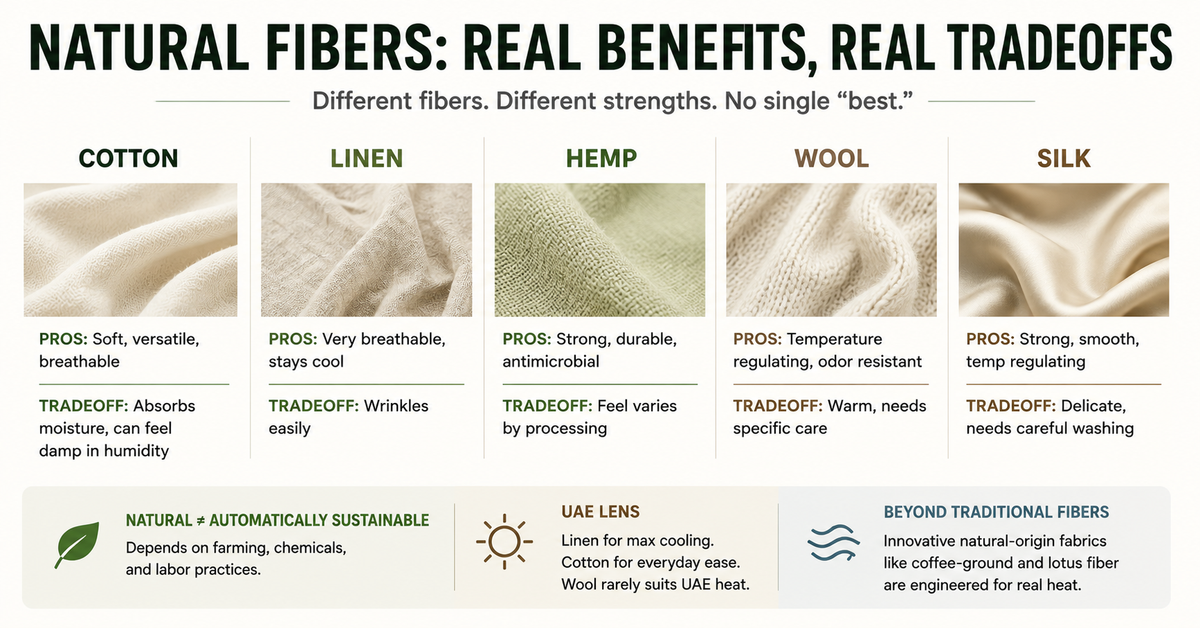
Organic cotton sold in the UAE is almost entirely imported, and the same certification logic applies regardless of where you're standing — a GOTS number is verifiable from Dubai exactly as it is from anywhere else. The one added wrinkle for UAE buyers: organic cotton is still cotton, meaning it carries the same moisture-absorbency tradeoff as conventional cotton in heat and humidity — organic certification changes how it was grown, not how it performs against skin in a Gulf summer.
At Okapi, we don't currently carry GOTS-certified organic cotton lines — our core materials are coffee-ground fabric and lotus fiber, which fall outside the traditional organic-cotton certification system entirely. We mention that plainly here rather than implying otherwise, because the whole point of this post is that specificity beats vague claims — including when the specific answer is "that's not what we make."
Frequently asked questions
Is "organic cotton" on a label enough to trust?
Not on its own — without a named, verifiable certification like GOTS, "organic" is an unregulated marketing term that can't be independently checked.
What's the difference between GOTS "organic" and "made with organic materials"?
"Organic" requires at least 95% certified organic fiber content; "made with organic materials" requires only 70%. Both are legitimate GOTS tiers, but they're different claims.
Does GOTS certification mean the whole garment is organic, including dye and thread?
Yes, if the finished garment itself carries GOTS certification — but if only the raw cotton was certified before further processing, the finished product may not qualify for the label at all.
Is OEKO-TEX the same as organic certification?
No — OEKO-TEX verifies the finished product is free of harmful chemical residues, but doesn't confirm the fiber was organically grown or address labor conditions the way GOTS does.