

What Is Recycled Polyester and Is It Really Sustainable?
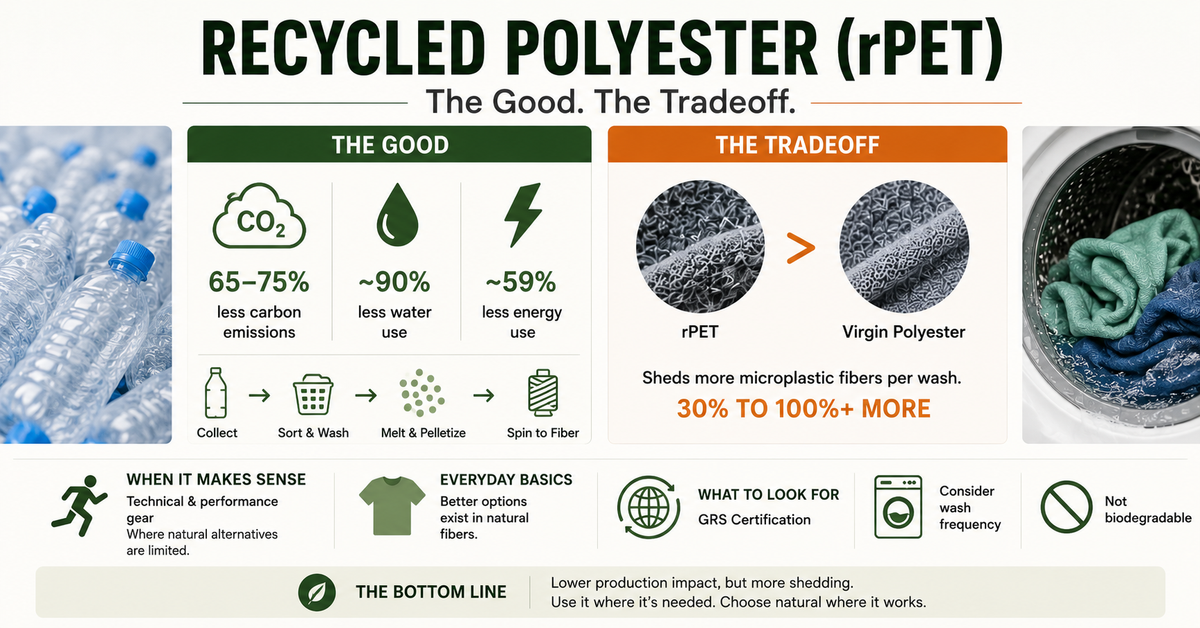
Short answer: Recycled polyester (rPET) is made mostly from used plastic bottles, and it genuinely cuts carbon emissions by 65-75% and water use significantly compared to virgin polyester. But it has a real, well-documented downside most marketing leaves out: rPET sheds more microplastic fibers per wash than virgin polyester, not fewer. It's not the clean win it's usually sold as — it's a genuine tradeoff.
This is the one that surprised me most researching this series, so let me lay out both sides honestly instead of picking the one that fits a tidier story.
The genuinely good part
rPET is made by collecting, sorting, washing, and melting down plastic bottles, then spinning the material into fiber. Compared to producing virgin polyester from raw petroleum, this process uses roughly 59% less energy, about 90% less water, and cuts carbon emissions by somewhere around 65-75%. Those aren't marketing numbers — they show up consistently across independent lifecycle assessments. Major brands including Patagonia, Adidas, and Nike have made real, large-scale commitments to rPET specifically because the production-stage benefit is genuinely significant, not greenwashed.
The part the marketing usually skips
Here's the honest complication: the mechanical recycling process that turns a bottle into fiber creates tiny fractures on the fiber's surface. That structural difference means rPET sheds more microplastic fibers during washing than virgin polyester of the same weight — not less. Studies on this vary in exact magnitude (one found around 31% more shedding, another found rPET could shed over twice as much under certain conditions), but they consistently point the same direction: recycling the bottle doesn't fix the microplastic-shedding problem. It's a separate issue entirely, and rPET doesn't solve it.
So the honest picture is: rPET is a real win on production-stage emissions and resource use, and a real step backward — or at best a wash — on the microplastic pollution the garment sheds for its entire lifespan after that.
Why this isn't a simple "avoid it" conclusion either
For some garment categories — technical sportswear, swimwear, backpacks, rain jackets — there often isn't an equally functional non-synthetic alternative available yet. In those specific cases, rPET's lower production footprint is a genuine improvement over virgin polyester, even with the shedding tradeoff acknowledged rather than ignored.
Where it gets genuinely questionable is everyday basics — t-shirts, underwear, casual wear — where natural fiber alternatives exist and perform just as well or better. Using rPET there mostly captures the marketing benefit ("made from recycled bottles!") without the functional necessity that makes the tradeoff worthwhile.
The "bottle in your t-shirt" claim, examined
A brand advertising a product as containing "X recycled bottles" is telling you something true but incomplete. It's also worth knowing: less than 1% of recycled textile fiber currently comes from actual old textile-to-textile recycling — almost all rPET still comes from bottles, not from recycled clothing. So "recycled polyester" and "recycled from old clothes" are, right now, almost never the same claim, even though marketing sometimes lets the two blur together.
How to actually evaluate a recycled polyester claim
- Ask what it's replacing. rPET replacing virgin polyester in technical gear is a real improvement. rPET replacing cotton in a basic tee is a lateral move at best.
- Look for GRS (Global Recycled Standard) certification, which verifies the recycled content claim and traceability — self-reported percentages without this are unverifiable.
- Consider how often you'll wash it. Since shedding happens in the wash, high-wash-frequency items (underwear, activewear, base layers) are where the microplastic downside compounds fastest.
- Don't assume "recycled" and "biodegradable" are related. rPET is still plastic — it doesn't break down naturally at end of life any more than virgin polyester does.
Where this leaves Okapi's own choices
We don't currently build the Café range around recycled polyester — coffee-ground fabric and lotus fiber are natural-origin materials without the microplastic-shedding tradeoff this article is about. That's a genuine reason we've made that material choice, not a coincidence, and it's worth being upfront about rather than staying vague on why.

Frequently asked questions
Does recycled polyester shed more microplastics than virgin polyester?
Yes, according to multiple independent studies — the mechanical recycling process creates surface fractures that increase fiber shedding during washing, typically by 30% or more compared to virgin polyester of the same weight.
Is recycled polyester still worth choosing over virgin polyester?
For technical or performance garments without a natural-fiber alternative, generally yes, due to significantly lower production emissions and water use. For everyday basics where natural fibers work fine, the case is weaker.
Is recycled polyester made from old clothes?
Almost never, currently — less than 1% of rPET comes from textile-to-textile recycling. The overwhelming majority comes from plastic bottles, not previously worn garments.
Is recycled polyester biodegradable?
No — it's still a plastic-based synthetic fiber and does not biodegrade any more readily than virgin polyester.