

Recycled vs Organic vs Natural: A Materials Glossary
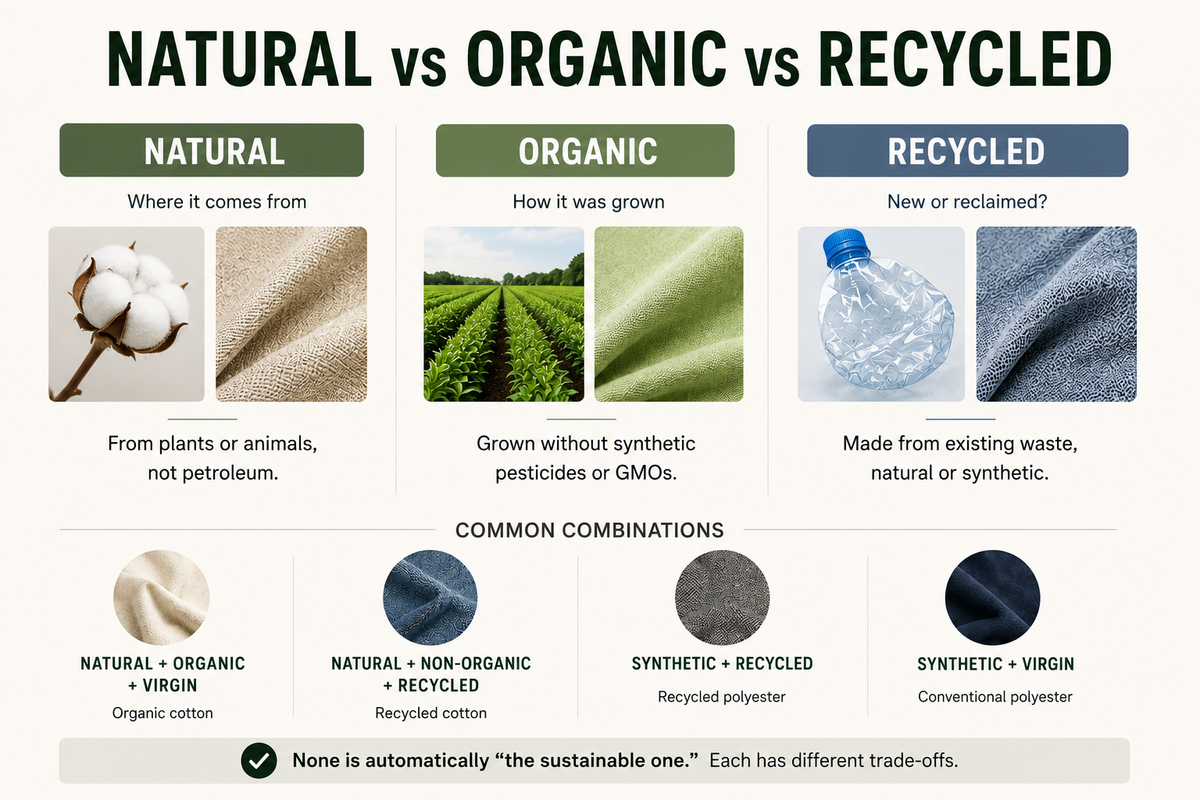
Short answer: These three words answer three completely different questions and get used interchangeably anyway. "Natural" describes where the fiber came from (plant or animal, not petroleum). "Organic" describes how a natural fiber was grown (no synthetic pesticides). "Recycled" describes whether the material is new or reclaimed from existing waste. A fabric can be any combination of these — recycled and synthetic, natural and non-organic, organic and virgin — and knowing which question each word is actually answering clears up most of the confusion.
Natural — answers "where did this fiber originate?"
Natural means the fiber came from a plant or animal — cotton, linen, hemp, wool, silk — rather than being synthesized from petroleum like polyester or nylon. That's the entire claim. Natural says nothing about pesticide use, labor conditions, chemical processing, or environmental impact during manufacturing. A natural fiber grown with heavy pesticide use and processed with harsh chemical dyes is still, technically, natural.
Organic — answers "how was this natural fiber grown?"
Organic only applies to natural fibers, and specifically addresses farming method: no synthetic pesticides, no synthetic fertilizers, no GMOs. Organic cotton uses meaningfully less water in typical cultivation than conventional cotton — one widely cited figure from Textile Exchange puts the reduction around 91% for irrigated organic cotton compared to conventional. That's a real, significant number. But organic says nothing about what happens after harvest — dyeing, finishing, and labor conditions are a separate question, which is exactly what certifications like GOTS exist to cover on top of the organic claim.
Recycled — answers "is this new material, or reclaimed?"
Recycled describes origin in a completely different sense: was the fiber made from virgin raw material, or reclaimed from existing waste (plastic bottles, factory offcuts, old garments)? Recycled fiber can be synthetic (recycled polyester) or natural (recycled cotton) — the word says nothing about which. And recycled fiber comes in two meaningfully different forms:
- Pre-consumer recycled: factory scraps and offcuts that never reached a customer. Cleaner waste stream, more consistent quality, easier to sort.
- Post-consumer recycled: reclaimed from actual used garments or products. Genuinely diverts household waste, but harder to sort by color and fiber blend, generally more labor-intensive to process.
Why mechanical recycling has a quality ceiling
Worth knowing regardless of which recycled fiber you're looking at: mechanical recycling — the dominant method — physically shreds material into raw fiber, which shortens and weakens the strands in the process. Recycled fiber quality is structurally lower than virgin fiber of the same type, every time, which is why most recycled cotton gets blended with virgin cotton or synthetic yarn for strength rather than used at 100% recycled content. Chemical recycling can preserve quality better but is more expensive and still scaling industrially — it's not yet the norm.
Why blended fabrics are the recycling industry's actual bottleneck
Most clothing today is a blend — cotton-polyester, cotton-elastane — and blended fabrics are dramatically harder to recycle back into anything, natural or synthetic, than a single-fiber garment. Separating two fiber types at end of life is technically difficult and often not economically worth doing. This is part of why "mono-material" design (a garment made from one fiber type throughout, including thread and labels) is gaining attention as a genuine circular-economy strategy — not a fabric type itself, but a design choice that makes future recycling actually feasible.
Putting the three words together
A fabric can combine these three independent questions in almost any way:
- Natural + organic + virgin: organic cotton, freshly grown, never recycled.
- Natural + non-organic + recycled: recycled cotton from old jeans, grown conventionally before recycling.
- Synthetic + recycled: recycled polyester from plastic bottles — never natural, never organic, but genuinely recycled.
- Synthetic + virgin: conventional polyester — none of the three.
None of these combinations is automatically "the sustainable one." Each carries its own tradeoffs, covered in more depth in our natural fiber guide, organic cotton breakdown, and recycled polyester piece.
In the UAE context
Since nearly everything sold here is imported, the "recycled" question in particular is hard to verify without a real certification (Global Recycled Standard is the one to look for) — self-reported percentages on a swing tag aren't independently checkable from Dubai any more than from anywhere else. The same rule applies across all three words: ask which specific question a claim is actually answering, then check whether there's a verifiable standard behind it.
Frequently asked questions
Is recycled fabric automatically more sustainable than natural fabric?
Not automatically — they answer different questions entirely. A recycled synthetic fiber and a virgin natural fiber both have real, different tradeoffs; neither category wins by default.
Can a fabric be both organic and recycled?
Rarely in practice — recycled fiber is reclaimed from existing waste, which by definition wasn't grown under a specific farm's current organic certification, so "organic recycled cotton" is uncommon and needs its own specific verification if claimed.
Why is post-consumer recycled fiber harder to process than pre-consumer?
Post-consumer waste (old garments) comes in mixed colors and fiber blends that are labor-intensive to sort, while pre-consumer waste (factory scraps) is typically more uniform and easier to process at scale.
Does recycled fiber ever match virgin fiber quality?
Generally no with mechanical recycling, which shortens and weakens fibers during the shredding process — chemical recycling can preserve more quality but remains more expensive and less widely available.